Grief support
A Balanced Way to Cope With Life After Loss
When you're grieving, it feels natural to put all your energy into managing the painful thoughts and feelings that arrived with your loved one's death. That instinct makes sense. For one thing, those emotions hurt, and you want relief.
Many of the best-known grief theories reinforce that focus, too. This is especially true of the models built on the "grief work hypothesis," which holds that coming to terms with a loss requires steady effort to face the death head-on. You may know these frameworks by their talk of "stages," "tasks," and "phases." That's a simplified summary, of course, and if you want to go deeper, there's a whole section here devoted to grief theory.
This isn't an attempt to argue against those models or the value of confronting the loss and working through hard emotion. Those things genuinely matter, and they're a vital part of grieving. But it can help to step back and take in the wider view of what it really means to cope with life after loss.
Since we're on the subject of theory, one more model is worth mentioning: the Dual Process Model of Coping with Bereavement (DPM). Theorists Stroebe and Schut introduced it in 1999, offering it as an answer to gaps they saw in the grief-work models that dominated at the time.
In short, the DPM describes how people cope after losing someone close. According to this model, coping unfolds inside the flow of ordinary daily life, and it centers on two kinds of stressors: loss-oriented and restoration-oriented. Here's the breakdown:
- Loss-oriented stressors involve processing the loss itself. This can look like longing, dwelling on the person who died, revisiting memories, and thinking about the death. You work through these stressors on and off, over time.
- Restoration-oriented stressors involve the attention you have to give to change and to secondary losses. That might mean taking on unfamiliar roles, handling finances, or reshaping your identity to fit a changed reality (Stroebe & Schut, 1999).
- Oscillation: A key idea in the DPM is "oscillation" — moving back and forth between loss-oriented and restoration-oriented stressors, along with occasional "confrontation-avoidance." In this view, stepping back and taking a break from grief is a healthy, adaptive move, as long as the avoidance doesn't become extreme or ongoing.
Now that you have a very basic picture of the DPM, here's why it resonates when it comes to living after a loss:
- It treats grief as an ongoing process you learn to live with. There's no final resolution, no finish line, no going back to "normal." Grief asks you to cope and adjust one day at a time.
- It recognizes the weight of secondary losses and secondary stressors, and the fact that a grieving person spends nearly as much time coping with those as with the loss itself.
- It recognizes that pausing from grief — and even the occasional suppression or avoidance of it — can be useful and adaptive. (If you want to understand the line between occasional avoidance and chronic, harmful avoidance, there's an article on that.)
How we think about coping
A lot of people assume that coping with life after loss is only about facing and managing painful grief emotions. We see coping more broadly: it includes anything that helps you feel better and gives you a lift of positive emotion. Taking a cue from the DPM, it's important to cope with the thoughts, experiences, and feelings tied directly to the loss. But it's just as important to cope in ways that support your adjustment and overall well-being — the "taking a break" kind of coping.
So coping can be something big, like seeing a therapist, or something small, like carving out time to play with your kids, walk your dog, or read for half an hour. The reasoning is simple: the better you feel, the more strength you'll have for the work of grief. It may not be obvious at first, but well-being coping and loss-related coping overlap a great deal. The coping you do to face the loss will build your sense of well-being, and much of what you do just to feel better will also help you carry the loss.
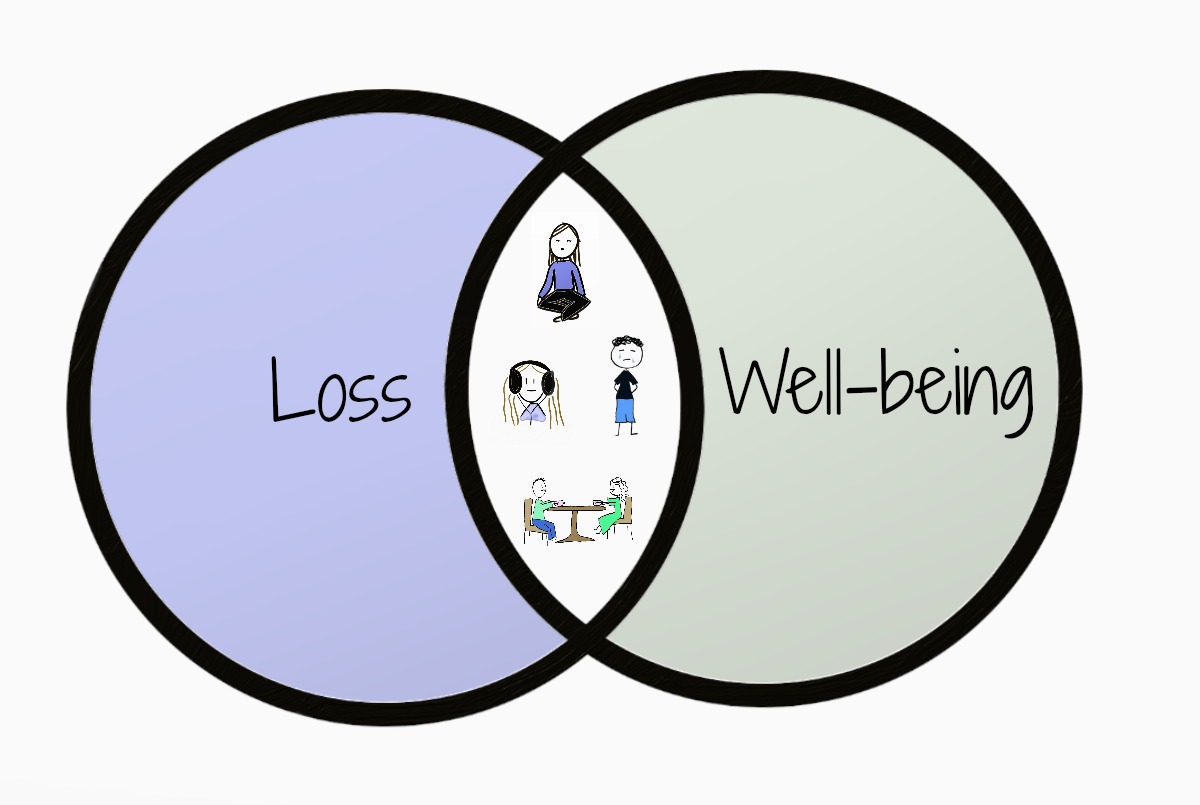
What does 'well-being coping' actually mean?
To define well-being coping, we'll borrow the framework of positive psychology's well-being theory, laid out by Martin Seligman in his book Flourish. It's a detailed theory, and we'll boil it down for this discussion.
Well-being is both the felt sense of feeling good and the very real experience of having meaning in your life, healthy relationships, and a sense of personal accomplishment. At its core, well-being theory points to five elements that work together to build it:
(1) Positive emotions: Even if a hopeful view of life feels far out of reach right now, there are things you can do to generally lift positive emotion. For instance, you can:
- Notice whether your current outlook has tipped into being overly negative.
- Give yourself permission to feel something good.
- Ask yourself: What do I enjoy? What makes me laugh? What gives me hope and optimism? What creative outlets do I like? What leaves me feeling intellectually engaged?
- Do more of those things.
(2) Engagement: Engagement is about activities that bring on a state of "flow." If "flow" is a new idea to you, the video below explains it well.
Engagement covers activities that pull you fully into the present, take up all your attention, and make time seem to fly. What counts as engaging is personal — it might be sports, music, cooking, photography, woodworking, reading, crossword puzzles, and on and on. Whatever absorbs you most, do more of it.
(3) Relationships: People are social creatures, and whether you call yourself an introvert or an extrovert, you need connection. Identify who's in your support system and tend to those relationships. If your support feels thin, reach out and connect with people in your community.
(4) Meaning: Meaning is about your sense of purpose. This is one area grief and loss hit especially hard. Even so, it can be redefined as you work directly through your grief-related emotions and experiences. Coping that may help strengthen a sense of meaning, or guide the search for it, includes:
- Journaling
- Reading
- Connecting with your faith
- Gratitude journaling
- Talking things through with a counselor, friend, or support group
- Volunteering (perhaps for a cause your loved one cared about)
- Advocacy (perhaps tied to your loved one's death)
(5) Accomplishments: Accomplishments are the personal achievements that leave you feeling satisfied and proud. They don't have to come with outward praise, awards, or titles, though they can. Something counts as an accomplishment if it simply gives you the gratification of knowing you succeeded, survived, or finished. What you've achieved, and what you'd like to achieve, is entirely your own. That said, we hope you'll count the progress you've made in grief among your accomplishments.
The specifics of what helps will depend on you and your situation, and support from a counselor or your own community can help you find the right balance.
Create a memorial for the person you love
Start with their name. It is free, takes a minute, and no account is needed.
This article is general information, not professional legal, financial, tax, or medical advice. The right steps depend on your situation and the laws of your state — when it matters, check with a qualified professional.